publications
2026
-
 Toward an SDG-Based Typology for US NonprofitsDominik S. Meier, and Elizabeth A. M. SearingBusiness Strategy and the Environment, 2026
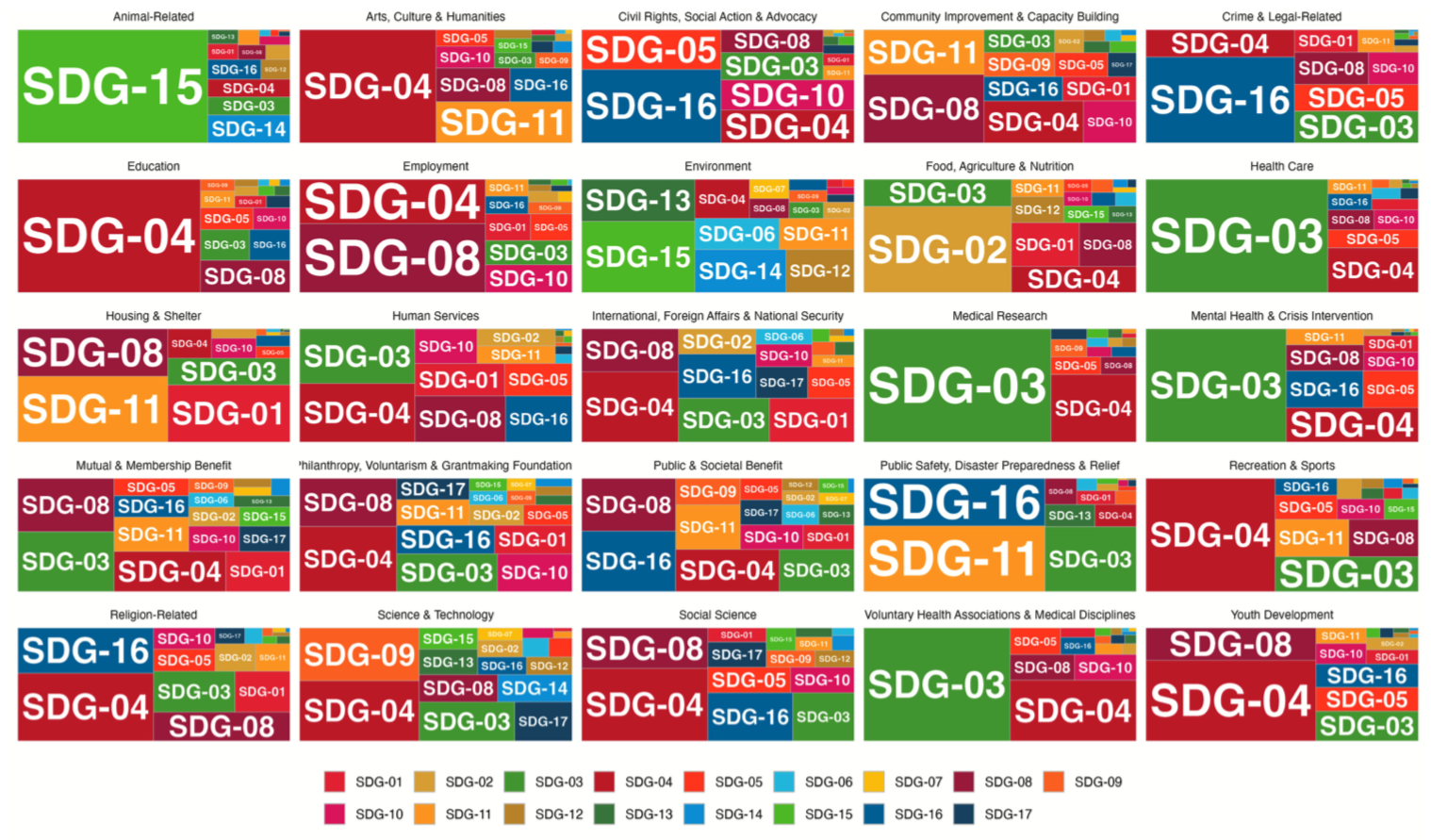
The Sustainable Development Goals (SDGs) represent an emerging institutional logic that nonprofits must navigate alongside existing sector-specific frameworks. Drawing on institutional logics and organizational hybridity theories, we examine how nonprofits incorporate SDGs into their missions and what this reveals about managing institutional complexity. Using a large language model to analyze nearly 50,000 US nonprofit mission statements, we develop an SDG-based typology that captures mission hybridity, a key dimension existing classification systems obscure. We find that nonprofits embedded in strong professional logics (e.g., healthcare, education) show concentrated SDG alignment, while those spanning multiple institutional spheres demonstrate diverse engagement patterns. Mission statements relate to an average of 1.94 SDGs, with modest intergoal correlations suggesting context-specific rather than template-driven implementation strategies. Our study advances understanding of how organizations translate global frameworks through existing institutional arrangements, provides a quantitative measure of mission complexity, and offers practical insights for nonprofit alignment with global sustainability priorities.

2025
-
 text2sdg: An R Package to Monitor Sustainable Development Goals from TextDominik S. Meier, Rui Mata, and Dirk U. WulffThe R Journal, 2025https://doi.org/10.32614/RJ-2024-005
Monitoring progress on the United Nations Sustainable Development Goals (SDGs) is important for both academic and non-academic organizations. Existing approaches to monitoring SDGs have focused on specific data types; namely, publications listed in proprietary research databases. We present the text2sdg package for the R language, a user-friendly, open-source package that detects SDGs in any kind of text data using different existing or custom-made query systems. The text2sdg package thereby facilitates the monitoring of SDGs for a wide array of text sources and provides a much-needed basis for validating and improving extant methods to detect SDGs from text.
-
 From Mission to Market: Assessing Sector Overlap Between Nonprofits and For-ProfitsDominik S. Meier, and Georg von SchnurbeinNonprofit and Voluntary Sector Quarterly, 2025
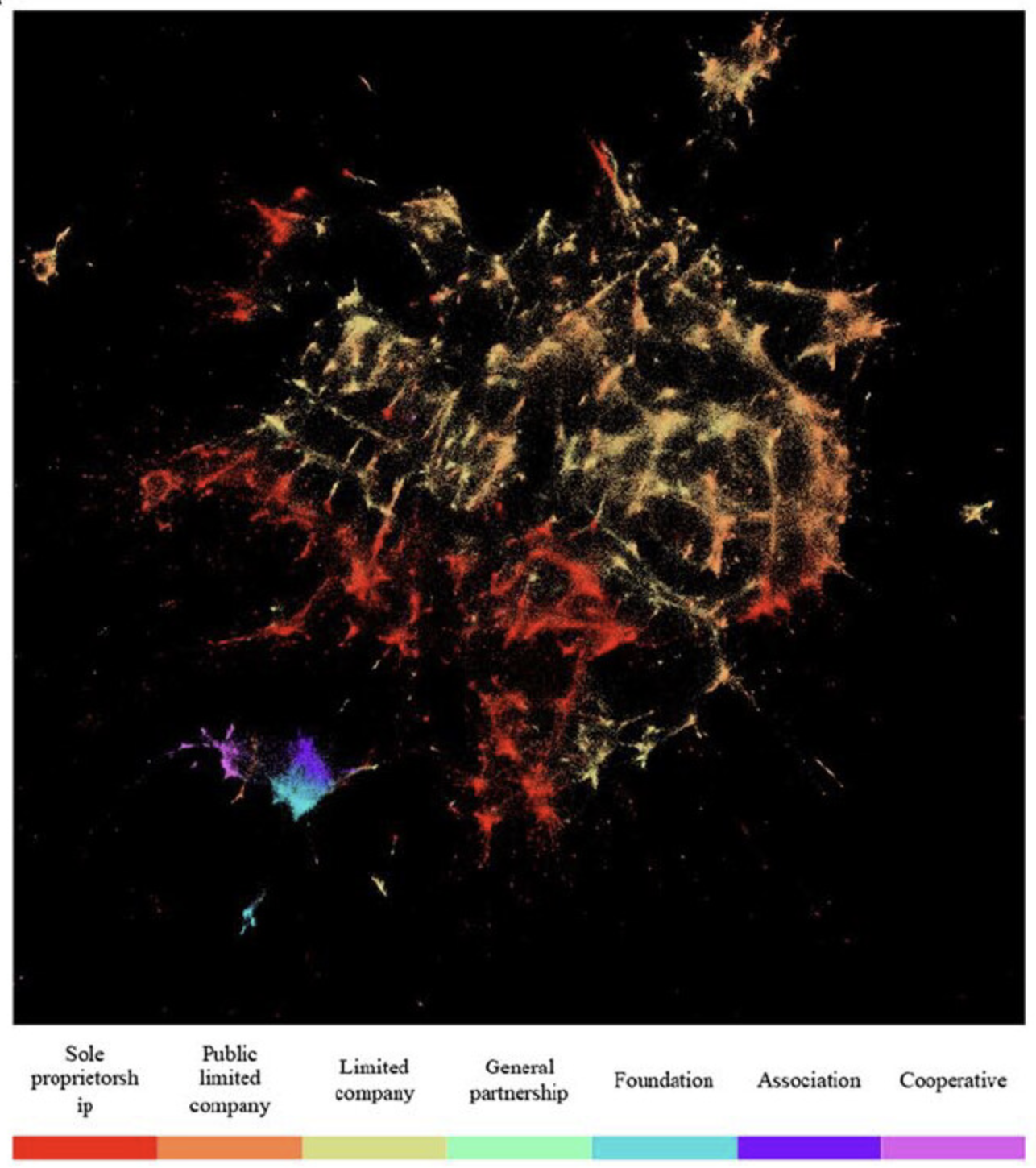
The ongoing debate about the distinctiveness of the nonprofit and for-profit sectors has intensified, particularly in light of recent research suggesting increasingly blurred boundaries due to the marketization of the nonprofit sector. In this study, we are the first to analyze mission statements (n = 611,077) from both sectors to examine their distinctiveness and potential overlap. Our findings reveal that while the two sectors remain largely distinct, there is also significant overlap. This similarity is driven by marketization, with nonprofit organizations showing greater alignment with the for-profit sector than the reverse. Our results underscore concerns about the marketization of the nonprofit sector, as we find a negative correlation between marketization (similarity to the for-profit sector) and the expressive functions of nonprofit organizations. Although nonprofit organizations exhibit both strong expressive and instrumental functions, these two dimensions are negatively correlated within the sector, highlighting an inherent trade-off.


2024
-
 Using novel data and ensemble models to improve automated labeling of Sustainable Development GoalsDirk U Wulff, Dominik S. Meier, and Rui MataSustainability Science, 2024
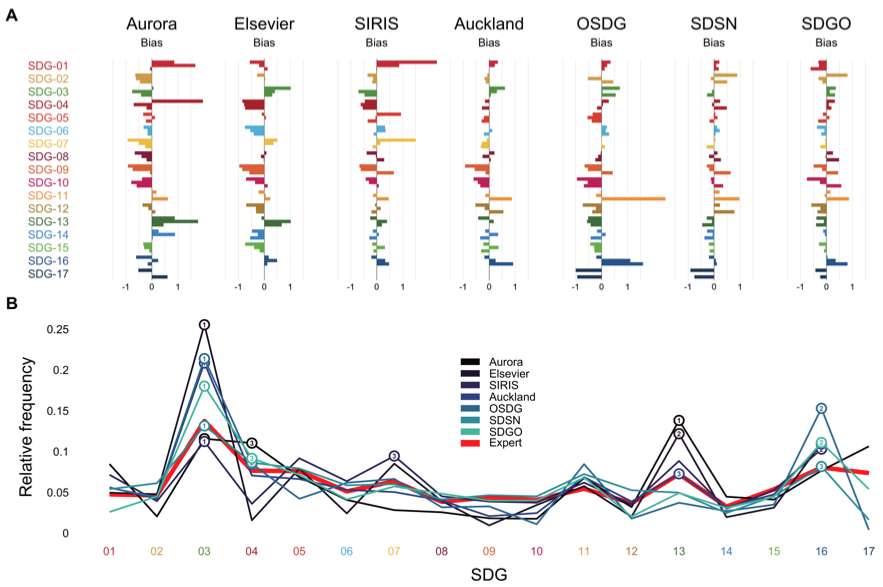
A number of labeling systems based on text have been proposed to help monitor work on the United Nations (UN) Sustainable Development Goals (SDGs). Here, we present a systematic comparison of systems using a va- riety of text sources and show that systems differ con- siderably in their specificity (i.e., true-positive rate) and sensitivity (i.e., true-negative rate), have systematic bi- ases (e.g., are more sensitive to specific SDGs relative to others), and are susceptible to the type and amount of text analyzed. We then show that an ensemble model that pools labeling systems alleviates some of these lim- itations, exceeding the labeling performance of all cur- rently available systems. We conclude that researchers and policymakers should care about the choice of label- ing system and that ensemble methods should be favored when drawing conclusions about the absolute and rela- tive prevalence of work on the SDGs based on automated methods.
-
 Compassion for all: Real-world online donations contradict compassion fadeDominik S. MeierNonprofit and Voluntary Sector Quarterly, 2024
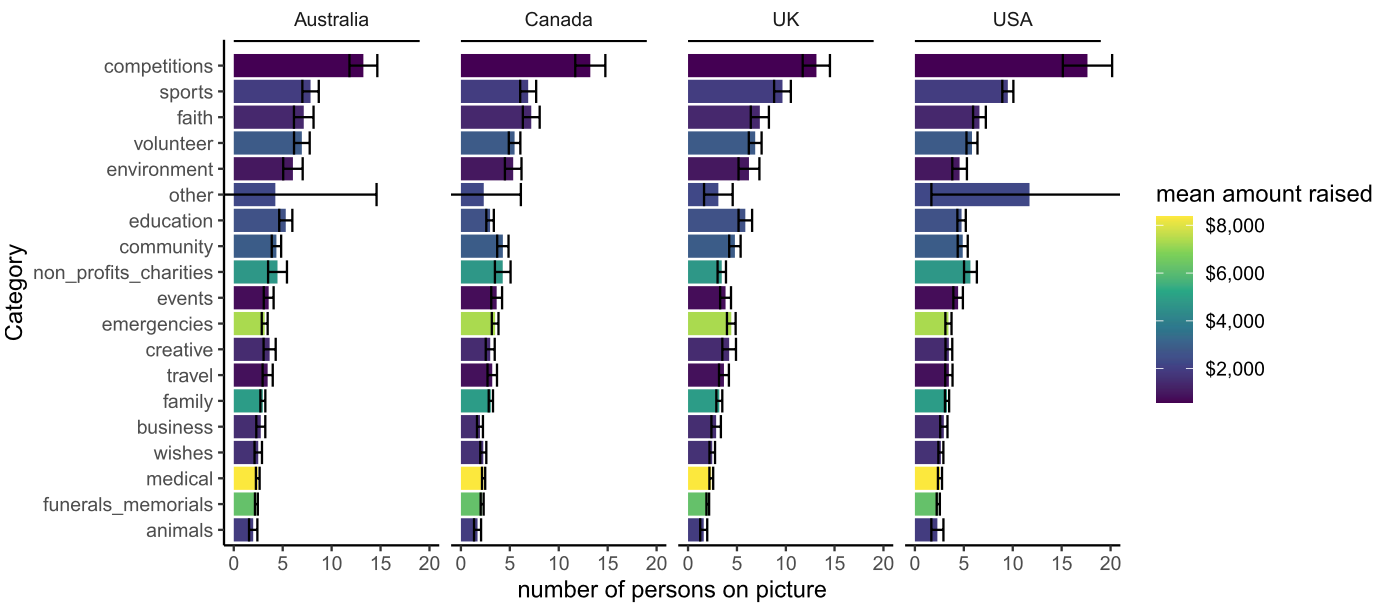
People tend to donate more to help a single rather than a group of victims. However, recent studies were able to reverse this compassion fade effect by presenting people with multiple donation appeals with different victim group sizes (joint evaluation) instead of just one donation appeal (separate evaluation). Because practitioners often use the compassion fade effect to boost giving, the reversal of this effect in joint evaluation settings has important implications for fundraising. This study tests whether the reversed compassion fade effect can be replicated in the field by using data from the crowdfunding platform GoFundMe. When browsing projects on GoFundMe, people see multiple projects displayed at once, placing them in a joint evaluation context. I found a concave effect of the perceived victim group size on the amount of funds raised, the number of donations received, and the size of the average donation received by a project.


2023
-
 The evolution of SDG-related third sector and public administration literature: an analysis and call for more SDG-related researchDominik S. MeierSustainability: Science, Practice and Policy, 2023
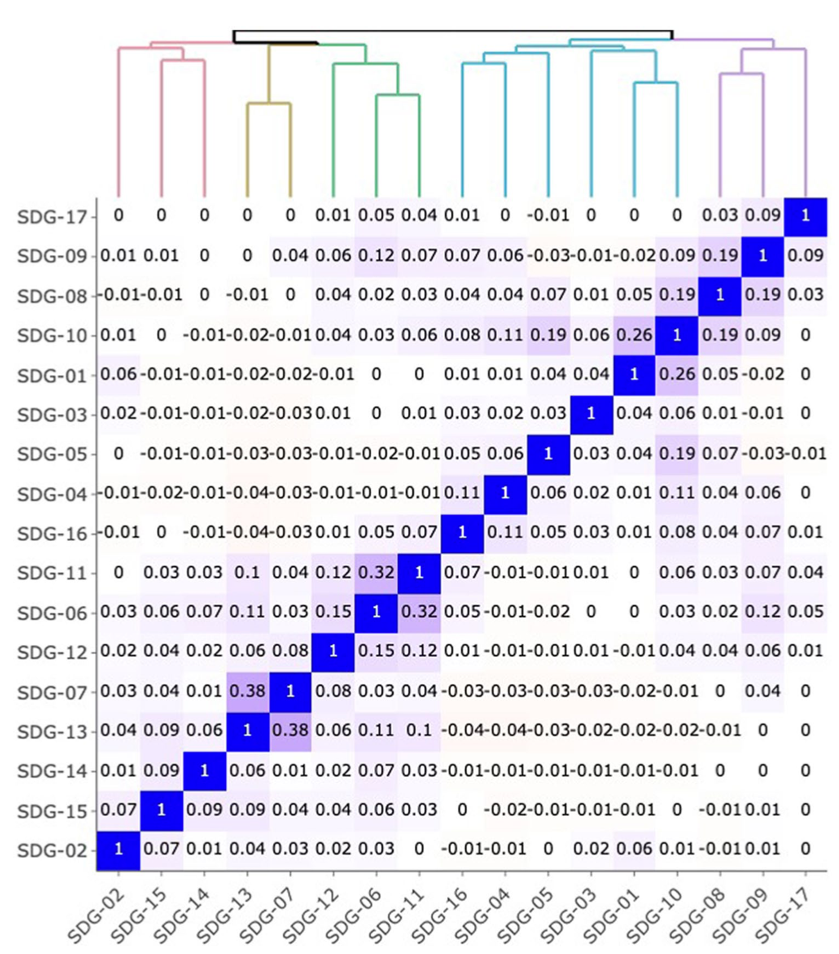
The seventeen Sustainable Development Goals (SDGs) were adopted in 2015 and achieving them by 2030 is crucial for human development. However, progress on the goals currently remains short of the requirements. As the third and public sectors play a crucial role in achieving the goals, this study analyzes how the SDG-related third sector and public administration literature has evolved over the last thirty years. I use a state-of-the-art method to map articles to the SDGs. In contrast to previous studies that have found an increase in publications that directly mention the SDGs, I find a decline in the proportion of articles that relate to the SDGs without necessarily mentioning them directly. I also analyze how the SDG-relatedness of an article corresponds to its citation count. While I find mixed results across SDGs and data sources, the relationship between SDG-relatedness and citation count is significantly more positive for work published after the adoption of the SDGs. While the association between SDG-relatedness and citation count is now positive for the third sector literature published after 2015, it is still negative for the public administration literature.
-
 Risking Your Health to Help Others: The Effect of Pandemic Severity on VolunteeringDominik S. Meier, Amadeus Petrig, and Georg von SchnurbeinNonprofit and Voluntary Sector Quarterly, 2023
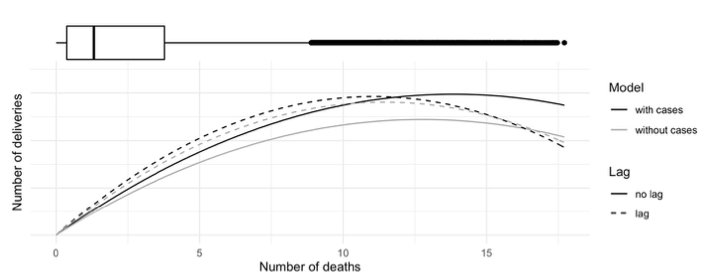
The COVID-19 pandemic affected the provision of voluntary work across the globe. We study informal volunteers who buy and deliver groceries for people in a high-risk group or in quarantine. Using data from a volunteering grocery delivering app in Switzerland that coordinated these volunteers, we are able to track volunteering during the pandemic. Combined with public health data on cases and deaths, we test how the severity of the pandemic affects the provision of voluntary work in the form of neighborhood grocery deliveries. We find a positive effect of the number of deaths on voluntary deliveries. However, in contrast to the literature studying the effect of the severity of the pandemic on giving, this effect is concave. We suggest that this concave effect is due to the signal of risk of infection implied by rising death rates, which is at odds with the signal of need to help others.


2021
-
 Risk preferences and risk perception affect the acceptance of digital contact tracingRebecca Albrecht, Jana B Jarecki, Dominik S. Meier, and <span class="more-authors" title="click to view 1 more author" onclick=" var element = $(this); element.attr('title', ''); var more_authors_text = element.text() == '1 more author' ? 'J"org Rieskamp' : '1 more author'; var cursorPosition = 0; var textAdder = setInterval(function(){ element.text(more_authors_text.substring(0, cursorPosition + 1)); if (++cursorPosition == more_authors_text.length){ clearInterval(textAdder); } }, '10'); " >1 more author</span>Humanities and Social Sciences Communications, 2021
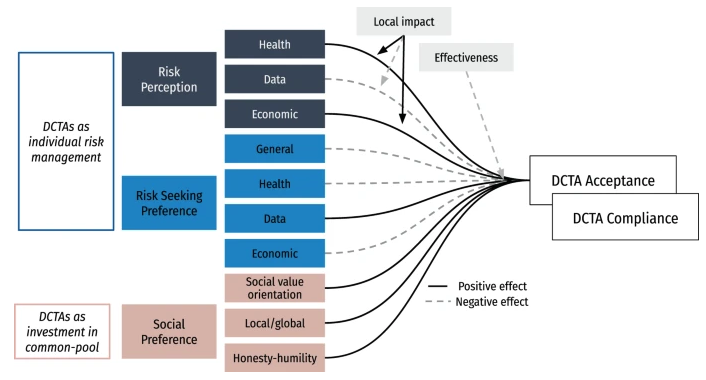
Digital contact-tracing applications (DCTAs) can help control the spread of epidemics, such as the coronavirus disease 2019 pandemic. But people in Western societies fail to install DCTAs. Understanding the low use rate is key for policy makers who support DCTAs as a way to avoid harsh nationwide lockdowns. In a preregistered study in a representative German-speaking Swiss sample (N = 757), the roles of individual risk perceptions, risk preferences, social preferences, and social values in the acceptance of and compliance with DCTA were compared. The results show a high compliance with the measures recommended by DCTAs but a comparatively low acceptance of DCTAs. Risk preferences and perceptions, but not social preferences, influenced accepting DCTAs; a high health-risk perception and a low data-security-risk perception increased acceptance. Additionally, support of political measures, technical abilities, and understanding the DCTA functionality had large effects on accepting DCTA. Therefore, we recommend highlighting personal health risks and clearly explaining DCTAs, focusing on data security, to enhance DCTA acceptance.
